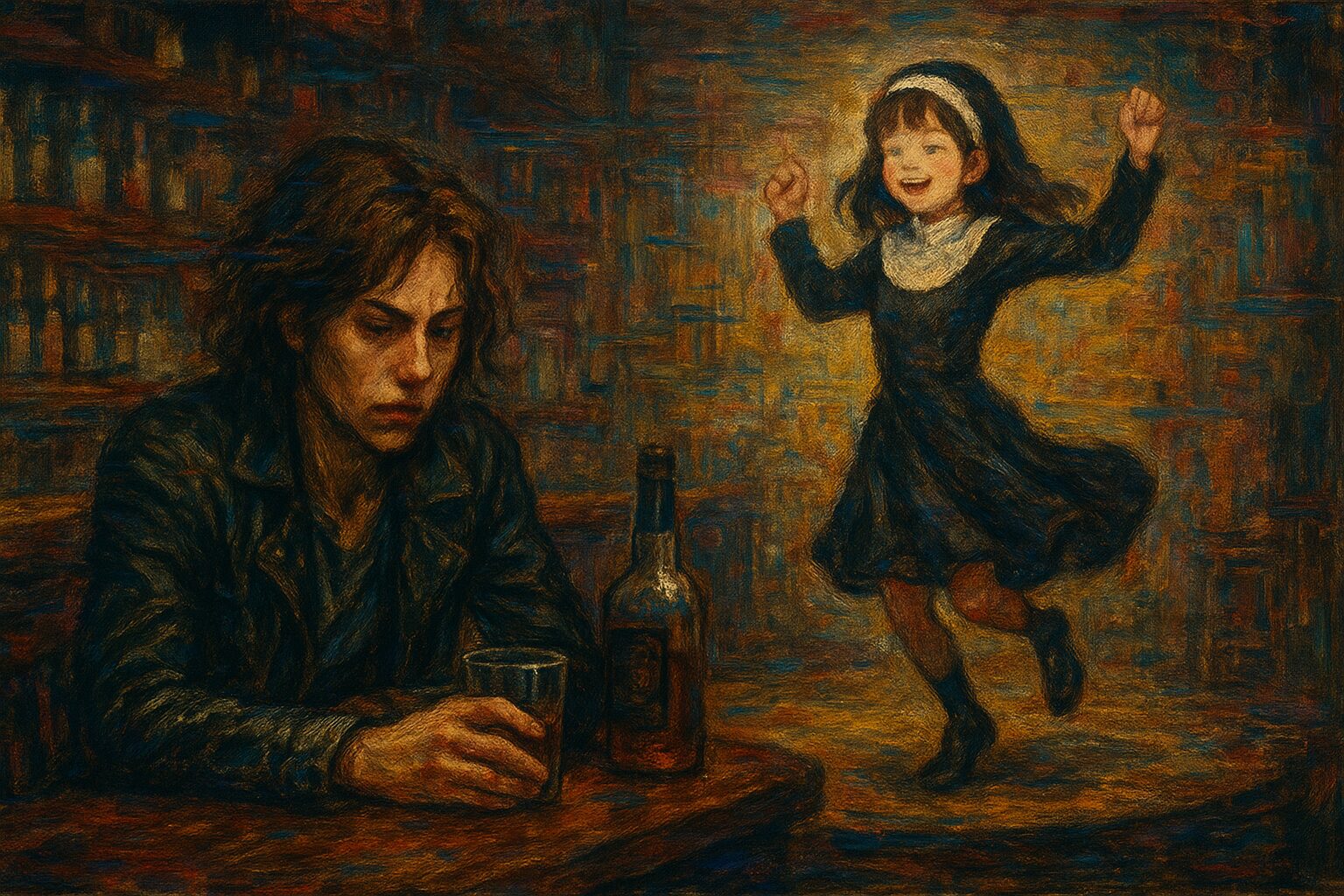
Give me your whiskey
Give me your whiskey
Give me my medicine
Give me my medicine
I found myself on the losing side
I wanted to live an ordinary life.
In Bourbon Street, where it’s cold and wintry
I’m walking around drinking with Jack Daniel
I got drunk and fell asleep in a back alley
My best friend died drunk in winter
I’m doing the same thing. Desperation
What did you want from me? I don’t know
Ah A A Ah
No more dreams
Ah A A Ah
No more fight
This is what I get for not getting what I wanted,
for indulging in fleeting pleasures
Nah Na Na Nah
No more whiskey
Nah Na Na Nah
No more medicine
With a mustard seed level of faith
Do I know what it means to live?
I am Sister Moka
I just want to do what I want to do
I’m dancing around a lot,
but I am doing my best sober
Ah A A Ah
No more dreams
Ah A A Ah
No more fight
This is what I get for not getting what I wanted,
for indulging in fleeting pleasures
Nah Na Na Nah
No more whiskey
Nah Na Na Nah
No more medicine
With a mustard seed level of faith
Do I know what it means to live?
Nah Na Na Nah
No more greed
Nah Na Na Nah
No more control
With a modesty of bread crumbs
Do I know what it means to live?
I am Sister Moka
I’m loved by people all over the world
I always dance with a smile on my face
I am doing my best sober
- Consideration
- Rahab drowning in alcohol – what remains “after the mission”
- Moka as “shadow” – another self, or the ideal she couldn’t keep
- Dialogue in the lyrics – two voices as one person’s inner conflict
- Alcohol and shadow – intoxication as a doorway to Moka
- Rahab’s past and the world – chaos and the apostle of love
- Is there salvation? – not a happy ending, but the beauty of suspension
- A meta reading – Moka as the digital “shadow”
- Conclusion – what Rahab and Moka’s story speaks to
Consideration
This song, given the premise that “the one drowning in alcohol is the former female spy Rahab and Moka is her shadow,” is not just about decadence or self-destruction. It portrays how a “person torn apart by the world” and “the shadow that belongs to her” try to coexist within one body and one life. At the same time, if we see Moka as Rahab’s shadow, the song becomes not only the story of two characters, but also the story of two conflicting drives inside a single person.
If we connect this to the RPG setting—where Rahab is a covert agent torn by a chaotic world and Moka is a wandering apostle of love—this song feels like an epilogue or a psychological side-story that takes place in the aftermath of those missions.
Rahab drowning in alcohol – what remains “after the mission”
The idea of “Rahab drowning in alcohol” strongly suggests a time after her career as a spy.
To live as an undercover operative in a turbulent world means constantly living with multiple lies, deceiving others, and splitting your own identity over and over. While she was on active missions, the narrative of “the mission” itself probably held her together. No matter how much her heart was grinding down, she could still cling to the idea that everything was for a cause.
However, when the mission is over and the world grows quiet, what remains is a hollow space:
“Who was I, really?”
“What was I living for?”
Drowning in alcohol becomes a temporary anesthetic for that void. At the same time, it’s a convenient mechanism that lets her blame the alcohol when her true feelings slip out. Regrets, guilt, and emotions cut off for the sake of her assignments may show themselves only when she’s drunk. In the song, Rahab seems to stand right on that threshold—between numb oblivion and painful self-awareness.
Moka as “shadow” – another self, or the ideal she couldn’t keep
Moka is described as Rahab’s “shadow” and as a “wandering messenger of love.”
This “shadow” can be read not simply as a partner or sidekick but in the psychological sense: the repressed desires, disowned traits, or even the ideal self Rahab wished she could have been but never chose.
- Rahab: the spy who has thrown many things away and been torn by the world’s chaos.
- Moka: the one who spreads love, someone who wants to save others.
The contrast is telling.
Rahab has sunk deep into the logic of darkness: covert operations, manipulation, moral ambiguity. In that world, kindness or open affection can be a liability.
Moka, by contrast, embodies the urge to connect through love, to reach out and heal. That urge must once have existed in Rahab too.
Seen this way, Moka becomes:
- a “possible self” that Rahab sacrificed for the sake of survival and duty, and
- a “what-if” life she might have led if she’d made different choices.
Dialogue in the lyrics – two voices as one person’s inner conflict
If the lyrics are structured with Rahab’s first-person lines and Moka’s whispers or refrain, it can look like a conversation between two people but actually be a dramatization of one person talking to herself.
- Rahab’s parts might contain:
- Self-deprecating words
- Lines that deny her own worth
- Images of decay: alcohol, night, cigarettes, cheap neon
- Moka’s parts might contain:
- Words insisting that “there is still love”
- A tone that neither denies Rahab’s past nor lets her drown in it
- Imagery of light, prayer, embrace, forgiveness
On the surface we hear a back-and-forth between Rahab and Moka. But at a deeper level this is Rahab’s internal dialogue:
- “Do I have any right to talk about love after what I’ve done?”
- “Can these guilty hands really hold someone?”
- “Which self should I live as—the one who knows everything, or the one who pretends not to?”
The song splits these conflicting wishes into two characters so that the listener can observe the struggle from the outside. It’s not just a stylistic trick; it’s a representation of a defensive mechanism—Rahab has to divide herself just to stay intact.
Alcohol and shadow – intoxication as a doorway to Moka
Given that Rahab “drowns in alcohol,” that state also becomes the condition that allows her shadow, Moka, to appear.
Sober Rahab, as a seasoned ex-spy, is governed by cold rationality and self-protection. She would deny her weaknesses and the inner voice that yearns for love with all her might.
But only when she’s drunk can the sealed-off shadow—Moka—stand beside her:
- Moka as a hallucination visible only through a haze of alcohol
- A second self sitting at the bar with her
- A figure speaking to her from the mirror behind the counter
From this angle, the song encourages us to wonder:
“Is Moka really there, or is she just something Rahab sees?”
Intoxication loosens the grip of reason.
What reason had pushed into the shadows—regret, sorrow, the desire to be held or to truly love—rises into view, wearing Moka’s face.
Thus, drowning in alcohol isn’t portrayed merely as moral collapse. It is also a pathway to the repressed parts of her psyche. That nuance gives the imagery of drinking a deeper, more human meaning.
Rahab’s past and the world – chaos and the apostle of love
In the broader narrative, Rahab is a covert agent torn apart by a chaotic world, while Moka is a wandering messenger of love. The disorder of the outer world and the presence of this “apostle of love” are closely tied to the theme of the song.
- The world is chaotic → justice and righteousness are unstable concepts.
- Living as a spy there → she doesn’t know who or what to believe.
- A “messenger of love” appears → someone presents a faith in love that seems impossibly pure.
Rahab must have seen many grand causes from the inside: political ideologies, religions, revolutions, systems of control and liberation. Each of them claims to be “right,” yet they often hurt and discard people.
To someone who has watched this from behind the curtain, the word “love” may feel like the most suspicious, intangible promise of all.
That is why Moka is, for her:
- a stand-in for a pure, untouched love that never seemed to exist in the real world, and
- perhaps, the last illusion she still wants to believe in.
The song’s drama is driven by whether Rahab will accept this “illusory voice” or keep rejecting it to the end.
Is there salvation? – not a happy ending, but the beauty of suspension
What makes the story compelling is that it doesn’t have to end with a simple “Rahab is saved.”
A very believable possibility is that:
- she cannot fully accept Moka’s words,
- yet she also realizes she needs them,
- so she keeps moving back and forth between the bottle and Moka’s presence.
This is a state of suspension, a kind of “stuckness.”
There is no total redemption, but there is no complete ruin either.
She returns to the same bar, the same glass, and once again talks with her shadow.
From one angle, that looks like she isn’t moving forward at all. But from another, it might be her only way of staying alive.
This ambiguous place between collapse and recovery is something many listeners can relate to. Real life rarely grants us dramatic catharsis. Most of the time we:
- want to change but cannot,
- wish to let go of the past but carry it anyway.
The relationship between Rahab and Moka symbolizes this “inability to fully change,” its sadness and its stubborn resilience.
A meta reading – Moka as the digital “shadow”
If the song belongs to a project involving digital art or music—NFTs, virtual characters, online communities—Moka takes on a further layer of meaning.
In that context, we can see:
- Rahab as the real, wounded self in the physical world, and
- Moka as the avatar or voice in the digital world that spreads love.
Then Moka is not only Rahab’s psychological shadow but also the projection of her feelings into the network. Thoughts and emotions she cannot express directly—vulnerability, longing, gentleness—flow into the world as song and character.
With this in mind, the dialogue in the lyrics becomes a conversation between:
- “the real self” and
- “the self that goes out into the world as a work of art.”
Listeners connect directly with the shadow side—Moka’s lines—and, through her, indirectly touch Rahab’s inner life.
Conclusion – what Rahab and Moka’s story speaks to
To sum up, this song can be seen as:
- The “after the mission” story of a former female spy, Rahab.
- A dialogue with her shadow, Moka, which she can reach only by drowning herself in alcohol.
- A portrayal of her struggle to see whether she can still believe in love in a chaotic world.
- On a meta level, a conversation between the real self and the self that exists as a character or work of art.
By the end, Rahab may not be fully saved.
Yet because Moka, her shadow, remains by her side, she also doesn’t completely break.
There is a faint hope in this refusal to shatter. The song quietly invites us to notice the Rahab and Moka within ourselves:
- the part that hates itself because of past choices and wounds, and
- the part that still wants to love and be loved.
Recognizing that both inhabit the same heart is the kind of fragile, honest acceptance this song seems to offer.



コメント